10.4 Regression
It is also possible to include covariates in the estimating procedure.
\[\begin{equation*}
P_k(t) = 1 - \exp\left\{-\Gamma_k(t)\exp\left(X\beta^{(k)}\right)\right\}, \quad
t > 0, \quad k = 1, 2, 3.
\end{equation*}\]
These equations are estimated separately. In R, this can be done with the package
cmprsk (Fine and Gray 1999; Gray 2011).
People born in Skellefteå in northern Sweden around the year 1800 are followed over time from 15 years of age to out-migration or death. Right censoring occurs for those who are still present on January 1, 1870. At exit the cause is noted, see Figure 10.2.
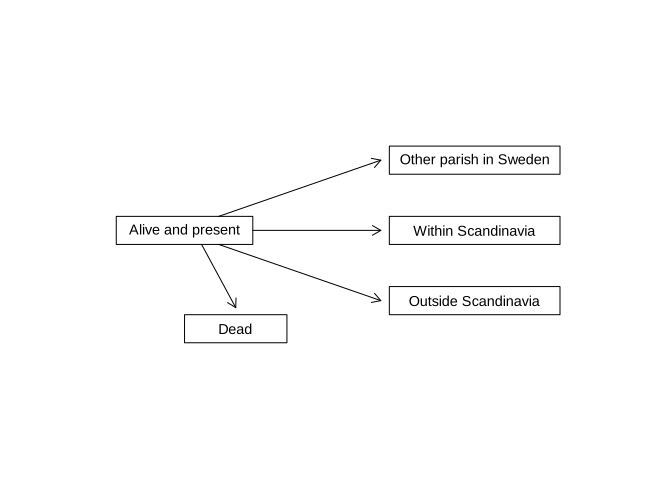
FIGURE 10.2: Mortality and emigration, Skellefteå, 1800–1870.
The data at hand looks like this:
##         Pnr      Mpnr      Fpnr birthdate enter     exit event parity  ab
## 1 801000758 775000541 771000493  1801.023    15 39.47241     2      3 leg
## 2 801000759 758000309 753000242  1801.028    15 50.00000     0      4 leg
## 3 801000760 770000458 765000452  1801.031    15 50.00000     0     10 leg
## 4 801000763 777000494 775000404  1801.039    15 26.10868     2      3 leg
## 5 801000768 780000572 774000453  1801.061    15 16.43292     2      2 leg
## 6 801000770 774000442 776000421  1801.072    15 48.59237     1      2 leg
A summary:
##    birthdate        enter         exit           event            parity
##  Min.   :1801   Min.   :15   Min.   :15.00   Min.   :0.0000   Min.   : 1.000
##  1st Qu.:1835   1st Qu.:15   1st Qu.:20.47   1st Qu.:0.0000   1st Qu.: 2.000
##  Median :1856   Median :15   Median :28.34   Median :0.0000   Median : 3.000
##  Mean   :1852   Mean   :15   Mean   :31.82   Mean   :0.7138   Mean   : 3.916
##  3rd Qu.:1872   3rd Qu.:15   3rd Qu.:44.82   3rd Qu.:2.0000   3rd Qu.: 6.000
##  Max.   :1886   Max.   :15   Max.   :50.00   Max.   :4.0000   Max.   :19.000
##      ab
##  leg  :16423
##  illeg:  850
##
##
##
##
##
## 0 1 2 3 4
## 10551 2102 4097 59 464The variable event is coded as shown in Table 10.1.
| Code | Meaning | Frequency |
|---|---|---|
| 0 | Censored | 10543 |
| 1 | Dead | 2102 |
| 3 | Moved to other parish in Sweden | 4097 |
| 4 | Moved to other Scandinavian country | 59 |
| 5 | Moved outside tha Scandinavian countries | 464 |
The code for the function comp is displayed at the end of this
chapter. It is not necessary to understand before reading on. It may be
useful as a template for those who wants to analyze competing risks.
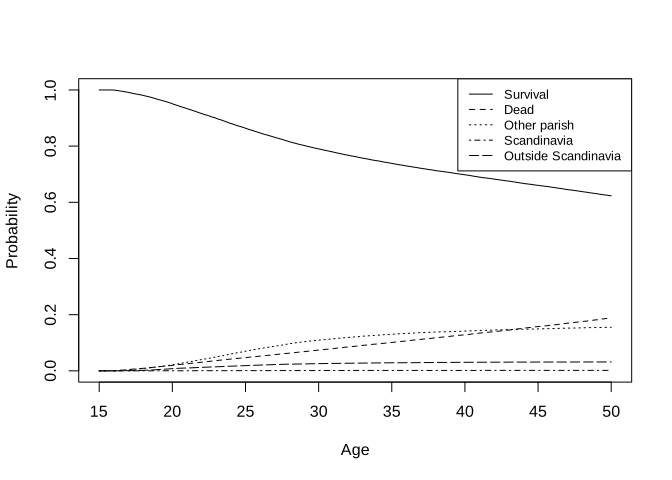
FIGURE 10.3: Cause-specific exit probabilities; mortality and migration from Skellefteå.
And with covariates and cmprsk; the syntax to get it done is a little
bit nonstandard. Here moving to other parish in Sweden is analysed
(failcode = 3).
library(cmprsk)
xx <- model.matrix(~ -1 + parity, zz)
fit <- crr(zz$exit, zz$event, xx, failcode = 3)
fit
## convergence: TRUE
## coefficients:
## parity
## 0.03927
## standard errors:
## [1] 0.04489
## two-sided p-values:
## parity
## 0.38Note that this is not Cox regression (but close!). The corresponding Cox regression is
Covariate           Mean       Coef     Rel.Risk   S.E.    LR p
parity              3.890     0.045     1.046     0.048    0.363

Events                    59
Total time at risk        290569
Max. log. likelihood      -548.83
LR test statistic         0.83
Degrees of freedom        1
Overall p-value           0.363362
References
Fine, J. P., and R. J. Gray. 1999. “A Proportional Hazards Model for the Subdistribution of a Competing Risk.” Journal of the American Statistical Association 94: 496–509.
Gray, Bob. 2011. Cmprsk: Subdistribution Analysis of Competing Risks. http://CRAN.R-project.org/package=cmprsk.