9.3 Aalen’s additive hazards model
In certain applications it may be reasonable to assume that risk factors acts additively rather than multiplicatively on hazards. Aalen’s additive hazards model (Aalen 1989, 1993) takes care of that.
For comparison, recall that the proportional hazards model may be written \[\begin{equation*} h(t\mid \mathbf{x_i}) = h_0(t) r\bigl(\boldsymbol{\beta}, \mathbf{x_i(t)}\bigr), \quad t > 0, \end{equation*}\] where \(r(\boldsymbol{\beta}, \mathbf{x_i})\) is a relative risk function. In Cox regression we (usually) have: \(r(\boldsymbol{\beta}, \mathbf{x_i}) = \exp(\boldsymbol{\beta}^T \mathbf{x_i})\),
The additive hazards model is given by \[\begin{equation*} h(t \mid \mathbf{x_i}) = h_0(t) + \beta_1(t) x_{i1}(t) + \cdots +\beta_p(t) x_{ip}(t), \quad t > 0, \end{equation*}\] where \(h_0(t)\) is the baseline hazard function, and \({\boldsymbol{\beta}(t)} = (\beta_0(t), \ldots, \beta_p(t))\) is a (multivariate) nonparametric regression function.
Note that \(h(t, \mathbf{x_i})\) may be negative, if some coefficients or variabless are negative. In contrast to the Cox regression model, there is no automatic protection against this.
The function aareg in the survival package fits the additive model.
## Call:
## aareg(formula = Surv(enter - 60, exit - 60, event) ~ sex, data = oldmort)
##
##   n= 6495
##     1805 out of 1806 unique event times used
##
##             slope      coef se(coef)     z         p
## Intercept  0.1400  0.000753 2.58e-05 29.20 9.82e-188
## sexfemale -0.0281 -0.000136 3.26e-05 -4.16  3.12e-05
##
## Chisq=17.34 on 1 df, p=3.12e-05; test weights=aalen
Obviously sex is an important variable, females have lower mortality than men.
Plots of the time-varying intercept and regression coefficient are given by
oldpar <- par(mfrow = c(1, 2))
plot(fit)
par(oldpar)
See Figure 9.2, where 95% confidence limits are added around
the fitted time-varying coefficients. Also note the use of the function
par; the first call sets the plotting area
to “one row and two columns” and saves the old par setting in
oldpar. Then the plotting area is restored to what it was earlier. It is a
good habit to always clean up for the next plotting enterprise.
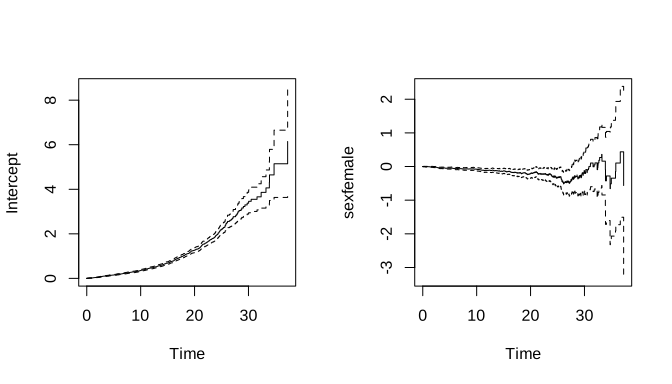
FIGURE 9.2: Cumulative intercept (left) and cumulative regression coefficient (right).
References
Aalen, O. O. 1989. “A Linear Regression Model for the Analysis of Life Times.” Statistics in Medicine 8: 907–25.
Aalen, O. 1993. “Further Results on the Non-Parametric Linear Model in Survival Analysis.” Statistics in Medicine 12: 1569–88.