4.4 Tabular lifetime data
Although it is possible to use Poisson regression in place of Cox regression, the most useful application of Poisson regression in survival analysis is with tabular data.
In eha, there is the data set swe07, which contains population
size and number of deaths by age and sex in Sweden 2007. The age span is
restricted to ages 61–80.
##     pop deaths    sex age  log.pop
## 1 63483    286 female  61 11.05853
## 2 63770    309 female  62 11.06304
## 3 64182    317 female  63 11.06948
## 4 63097    366 female  64 11.05243
## 5 61671    387 female  65 11.02957
## 6 57793 419 female 66 10.96462## pop deaths sex age log.pop
## 35 31074 884 male 75 10.34413
## 36 29718 904 male 76 10.29951
## 37 29722 1062 male 77 10.29964
## 38 28296 1112 male 78 10.25048
## 39 27550 1219 male 79 10.22376
## 40 25448 1365 male 80 10.14439The Poisson model is, where \(D_{ij}\) is number of deaths and \(P_{ij}\)
population size for age \(i\) and sex \(j\), \(i = 61, \ldots, 80\);
\(j = \text{female (0)}, \text{male (1)}\), and \(\lambda_{ij}\) is the corresponding
mortality,
\[\begin{equation*} D_{ij} \sim \text{Poisson}(\lambda_{ij} P_{ij}), \quad i = 61, 62, \ldots, 80; \; j = 0, 1, \end{equation*}\]
with
\[\begin{equation*} \begin{split} \lambda_{61,j} P_{61,j} &= P_{61,j}\exp(\gamma + \beta * j) \\ &= \exp(\log(P_{61,j}) + \gamma + \beta * j), \quad j = 0, 1, \end{split} \end{equation*}\]
and
\[\begin{equation*} \begin{split} \lambda_{ij} P_{ij} &= P_{ij} \exp(\gamma + \alpha_i + \beta * j) \\ &= \exp(\log(P_{ij}) + \gamma + \alpha_i + \beta * j), \quad i = 62, 63, \ldots, 80; \; j = 0, 1. \end{split} \end{equation*}\]
This calculation shows that it is the log of the population sizes
(\(\log(P_{ij}\)) that is the correct offset to use in the Poisson regression.
First we want age to be a factor (no restrictions like linearity),
then the R function glm (“generalized linear model”) is used to
fit a Poisson regression model.
swe07$age <- factor(swe07$age)
fit <- glm(deaths ~ offset(log.pop) + sex + age, family = poisson,
           data = swe07)
drop1(fit, test = "Chisq")
## Single term deletions
##
## Model:
## deaths ~ offset(log.pop) + sex + age
## Df Deviance AIC LRT Pr(>Chi)
## <none> 10.2 382.8
## sex 1 1428.0 1798.5 1417.7 < 2.2e-16 ***
## age 19 9764.6 10099.2 9754.4 < 2.2e-16 ***
## ---
## Signif. codes: 0 '***' 0.001 '**' 0.01 '*' 0.05 '.' 0.1 ' ' 1The function drop1 is used above to perform two LR tests. The results
are that both variables are highly statistically significant, meaning that
both are very important in describing the variation in mortality over sex
and age. To know how, we present the parameter estimates.
##
## Call:
## glm(formula = deaths ~ offset(log.pop) + sex + age, family = poisson,
##     data = swe07)
##
## Deviance Residuals:
##      Min        1Q    Median        3Q       Max
## -0.94763  -0.40528   0.00104   0.32469   1.00890
##
## Coefficients:
##             Estimate Std. Error  z value Pr(>|z|)
## (Intercept) -5.41436    0.03777 -143.358  < 2e-16 ***
## sexmale      0.46500    0.01246   37.311  < 2e-16 ***
## age62        0.04018    0.05171    0.777  0.43705
## age63        0.15654    0.05019    3.119  0.00181 **
## age64        0.28218    0.04896    5.764 8.23e-09 ***
## age65        0.36374    0.04834    7.524 5.30e-14 ***
## age66        0.48712    0.04786   10.178  < 2e-16 ***
## age67        0.61210    0.04755   12.873  < 2e-16 ***
## age68        0.62987    0.04868   12.938  < 2e-16 ***
## age69        0.81418    0.04742   17.168  < 2e-16 ***
## age70        0.81781    0.04744   17.239  < 2e-16 ***
## age71        0.93264    0.04690   19.887  < 2e-16 ***
## age72        1.03066    0.04659   22.122  < 2e-16 ***
## age73        1.12376    0.04618   24.334  < 2e-16 ***
## age74        1.27287    0.04548   27.985  < 2e-16 ***
## age75        1.37810    0.04507   30.577  < 2e-16 ***
## age76        1.45245    0.04481   32.413  < 2e-16 ***
## age77        1.61461    0.04366   36.979  < 2e-16 ***
## age78        1.73189    0.04317   40.115  < 2e-16 ***
## age79        1.83958    0.04266   43.125  < 2e-16 ***
## age80        2.00326    0.04217   47.502  < 2e-16 ***
## ---
## Signif. codes:  0 '***' 0.001 '**' 0.01 '*' 0.05 '.' 0.1 ' ' 1
##
## (Dispersion parameter for poisson family taken to be 1)
##
##     Null deviance: 10876.873  on 39  degrees of freedom
## Residual deviance:    10.232  on 19  degrees of freedom
## AIC: 382.81
##
## Number of Fisher Scoring iterations: 3
The results so tell us that males have a distinctly higher mortality than
females, and that mortality steadily increases with age (no
surprises!). The parameter estimates for age also opens up the
possibility to simplify the model by assuming a linear or quadratic effect
of age on mortality. We leave that possibility for later.
One question remains: Is the female advantage relatively the same over ages? To answer that question, we introduce an interaction:
fit1 <- glm(deaths ~ offset(log.pop) + sex * age,
            family = poisson, data = swe07)
drop1(fit1, test = "Chisq")
## Single term deletions
##
## Model:
## deaths ~ offset(log.pop) + sex * age
## Df Deviance AIC LRT Pr(>Chi)
## <none> 0.000 410.58
## sex:age 19 10.232 382.81 10.232 0.947Note that the drop1 function only tests the interaction term. This is
because, as we saw before, the main effects tend to be meaningless in the
presence of interaction. However, here there is no sign of interaction, and
we can conclude that in a survival model with sex as covariate, we
have proportional hazards! This is most easily seen in
graphs. The first plot is based on the estimated Poisson model
without interaction. Some calculations are first needed.
beta <- coefficients(fit)[2]
alpha <- coefficients(fit)[-2] # Remove sex
alpha[2:length(alpha)] <- alpha[2:length(alpha)] + alpha[1]
lambda.females <- exp(alpha)
lambda.males <- exp(alpha + beta)
Then the plot of the hazard functions by
plot(61:80, lambda.males, ylim = c(0, 0.06), xlab = "Age",
     type = "s")
lines(61:80, lambda.females, type = "s", lty = 2)
abline(h = 0)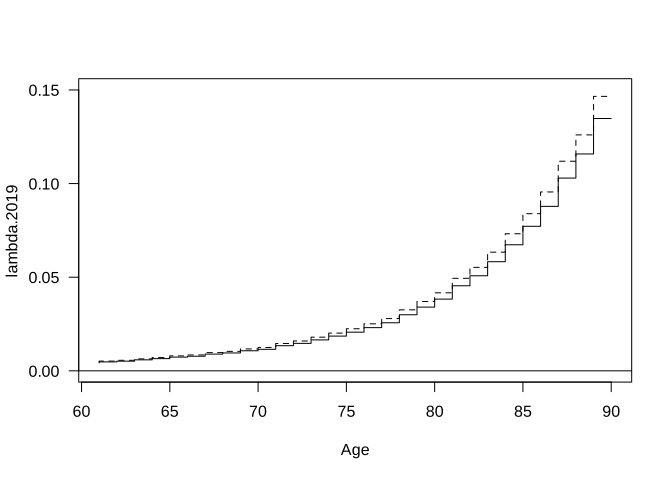
Note the parameter ylim. It sets the scale on the \(y\) axis, and some
trial and error may be necessary to get a good choice.
The function line adds a curve to an already
existing plot, and the function abline
adds a straight line; the argument h = 0 results in a
horizontal line. See the help pages for these functions for further
information.
The result is shown in Figure 4.4.
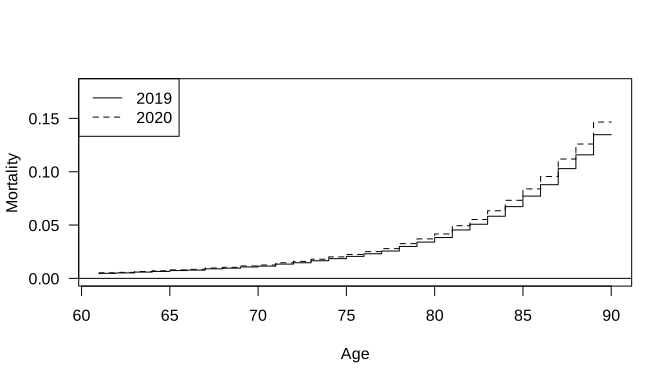
FIGURE 4.4: Model based hazard functions for males (upper) and females (lower).
We can also make a plot based only on raw data. For that it is only necessary to calculate the occurrence-exposure rates. An occurrence-exposure rate is simply the ratio between the number of occurrences (of some event) divided by total exposure (waiting) time. In the present example, mean population size during one year is a very good approximation of the exact total exposure time (in years).
femal <- swe07[swe07$sex == "female", ]
mal <- swe07[swe07$sex == "male", ]
f.rate <- femal$deaths / femal$pop
m.rate <- mal$deaths / mal$pop
And finally the plot of the raw death rates is created as follows,
plot(61:80, m.rate, ylim = c(0, 0.06), xlab = "Age",
     ylab = "Mortality", type = "s")
lines(61:80, f.rate, lty = 2, type = "s")
abline(h = 0)
with the result as shown in Figure 4.5.
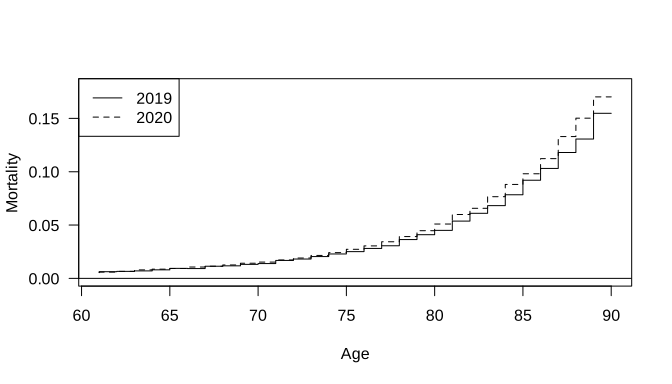
FIGURE 4.5: Hazard functions for males (upper) and females (lower) based on raw data.
The differences between Figure 4.4 and Figure 4.5 are very small, showing that the Poisson model without interaction fits the Swedish old age mortality data very well. \(\Box\)