3.1 Proportional Hazards
The property of proportional hazards is fundamental in Cox regression. It is in fact the essence of Cox’s simple yet ingenious idea. The definition is as follows:
Definition 3.1 (Proportional hazards) If \(h_1(t)\) and \(h_0(t)\) are hazard functions from two separate distributions, we say that they are proportional if
\[\begin{equation} h_1(t) = \psi h_0(t), \quad \text{for all } t \ge 0, \tag{3.1} \end{equation}\] for some positive constant \(\psi\) and all \(t \ge 0\). Further, if holds, then the same property holds for the corresponding cumulative hazard functions \(H_1(t)\) and \(H_0(t)\).
\[\begin{equation} H_1(t) = \psi H_0(t), \quad \text{for all } t \ge 0, \tag{3.2} \end{equation}\] with the same proportionality constant \(\psi\) as in (3.1).\(\Box\)Strictly speaking, the second part of this definition follows easily from the first (and vice versa), so more correct would be to state one part as a definition and the other as a corollary. The important part of this definition is “\(\textit{for all }t \ge 0\)”, and that the constant \(\psi\) does not depend on \(t\). Think of the hazard functions as age-specific mortality for two groups, e.g., women and men. It is “well known” that women have lower mortality than men in all ages. It would therefore be reasonable to assume proportional hazards in that case. It would mean that the female relative advantage is equally large in all ages. See Example ?? for a demonstration of this example of proportional hazards.
It must be emphasized that this is an assumption that always must be carefully checked. In many other situations, it would not reasonable to assume proportional hazards. If in doubt, check data by plotting the Nelson-Aalen estimates for each group in the same plot.
See Figure 3.1 for an example with two Weibull hazard functions and the proportionality constant \(\psi = 2\).
## Loading required package: survival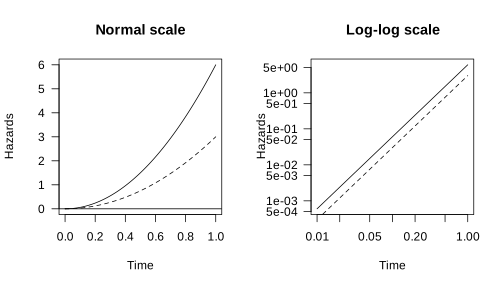
FIGURE 3.1: Two hazard functions that are proportional. The proportionality constant is 2.
The proportionality is often difficult to judge by eye, so in order make it easier to see, the plot can be made on a log scale, see Figure 3.2.
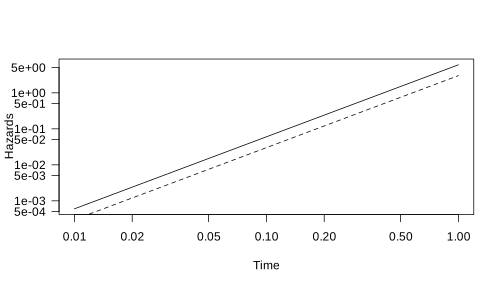
FIGURE 3.2: Two hazard functions that are proportional are on a constant distance from each other on a log-log scale. The proportionality constant is 2, corresponding to a vertical distance of log(2) = 0.693.
Note that both dimensions are on a log scale. This type of plot, constructed from empirical data, is called a Weibull plot in reliability applications: If the lines are straight lines, then data are well fitted by a Weibull distribution. Additionally, if the the slope of the line is 1 (45 degrees), then an exponential model fits well.
To summarize Figure 3.2: (i) The hazard functions are proportional because on the log-log scale, the vertical distance is constant, (ii) Both hazard functions represent a Weibull distribution, because both lines are straight lines, and (iii) neither represents an exponential distribution, because the slopes are not one. This latter fact may be difficult to see because of the different scales on the axes (the aspect ratio is not one).