1.4 Time scales
In demographic applications age is often a natural time scale, that is, time is measured from birth. In the old age data just discussed, time was measured from age 60 instead. In a case like this, where there is a common ``late start age’’, it doesn’t matter much, but in other situations it does. Imagine for instance that interest lies in studying the time it takes for a woman to give birth to her first child after marriage. The natural way of measuring time is to start the clock at the day of marriage, but a possible (but not necessarily recommended!) alternative is to start the clock at some (small) common age of the women, for instance at birth. This would give left truncated (at marriage) observations, since women were sampled at marriage. There are two clocks ticking, and you have to make a choice.
Generally, it is important to realize that there often are alternatives, and that the result of an analysis may depend strongly on the choice made.
1.4.1 The Lexis diagram
Two time scales are nearly always present in demographic research: Age (or duration) and calendar time. For instance, an investigation of mortality may be limited in these two directions. In Figure this is illustrated for a study of old age mortality during the years 1829 and 1895. ``Old age mortality’’ is defined as mortality from age 50 and onwards to age 100. The Lexis diagram is a way of showing the interplay between the two time scales and (human) life lines. Age moves vertically and calendar time horizontally, which will imply that individual lives will move diagonally, from birth to death, from south-west to north-east, in the Lexis diagram. In our example study, we are only interested in the part of the life lines that appear inside the rectangle.
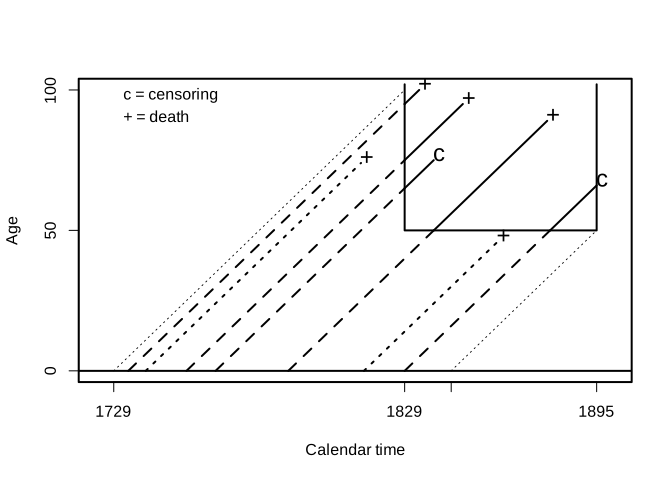
FIGURE 1.3: Lexis diagram: time period 1829–1894 and ages 50–100.
Assume that the data set at hand is saved in the text file ‘lex.dat’. Note that this data set is not part of eha; it is only used here for the illustration of the Lexis diagram.
##   id enter   exit event birthdate    sex
## 1  1     0 98.314     1  1735.333   male
## 2  2     0 87.788     1  1750.033   male
## 3  3     0 71.233     0  1760.003 female
## 4  4     0 87.965     1  1799.492   male
## 5  5     0 82.338     1  1829.003 female
## 6  6     0 45.873     1  1815.329 female
## 7  7     0 74.112     1  1740.513 female
How do we restrict the data to fit into the rectangle given by the Lexis diagram in Figure 1.3? With the two functions age.window and cal.window it is easy. The former fixes the ‘age cut’ while the latter makes the ‘calendar time cut’.
The age cut:
##   id enter   exit event birthdate    sex
## 1  1    50 98.314     1  1735.333   male
## 2  2    50 87.788     1  1750.033   male
## 3  3    50 71.233     0  1760.003 female
## 4  4    50 87.965     1  1799.492   male
## 5  5    50 82.338     1  1829.003 female
## 7  7    50 74.112     1  1740.513 female
Note that individual No. 6 dropped out completely because she died too young. Then the calendar time cut:
##   id  enter   exit event birthdate    sex
## 1  1 93.667 98.314     1  1735.333   male
## 2  2 78.967 87.788     1  1750.033   male
## 3  3 68.997 71.233     0  1760.003 female
## 4  4 50.000 87.965     1  1799.492   male
## 5  5 50.000 65.997     0  1829.003 female
and here individual No. 7 disappeared because she died before January 1, 1829. Her death date is her birth date plus her age at death, \(1740.513 + 74.112 = 1814.625\), or August 17, 1814.