8.1 An Introductory Example
Let us assume that in a follow-up study, the cohort is not homogeneous but instead consists of two equally sized groups with differing hazard rates. Assume further that we have no indication of which group an individual belongs to, and that members of both groups follow an exponential life length distribution: \[\begin{equation*} \begin{split} h_1(t) &= \lambda_1 \\ h_2(t) &= \lambda_2 \\ \end{split} \qquad t > 0. \end{equation*}\] This implies that the corresponding survival functions \(S_1\) and \(S_2\) are \[\begin{equation*} \begin{split} S_1(t) &= e^{-\lambda_1 t} \\ S_2(t) &= e^{-\lambda_2 t} \\ \end{split} \qquad t > 0, \end{equation*}\] and a randomly chosen individual will follow the “population mortality” \(S\), which is a mixture of the two distributions: \[\begin{equation*} S(t) = \frac{1}{2} S_1(t) + \frac{1}{2} S_2(t), \quad t > 0. \end{equation*}\] Let us calculate the hazard function for this mixture. We start by finding the density function \(f\): \[\begin{equation*} f(t) = -\frac{dS(x)}{dx} = \frac{1}{2}\left(\lambda_1 e^{-\lambda_1 t} + \lambda_2 e^{-\lambda_2 t} \right), \quad t > 0. \end{equation*}\] Then, by the definition of \(h\) we get \[\begin{equation} h(t) = \frac{f(t)}{S(t)} = \omega(t) \lambda_1 + \big(1 - \omega(t)\big) \lambda_2, \quad t > 0, \tag{8.1} \end{equation}\] with \[\begin{equation*} \omega(t) = \frac{e^{-\lambda_1 t}}{e^{-\lambda_1 t} + e^{-\lambda_2 t}} \end{equation*}\] It is easy to see that \[\begin{equation*} \omega(t) \rightarrow \left\{ \begin{array}{ll} 0, & \lambda_1 > \lambda_2 \\ \frac{1}{2}, & \lambda_1 = \lambda_2 \\ 1, & \lambda_1 < \lambda_2 \end{array} \right. , \quad \mbox{as } t \rightarrow \infty, \end{equation*}\] implying that \[\begin{equation*} h(t) \rightarrow \min(\lambda_1, \lambda_2), \quad t \rightarrow \infty, \end{equation*}\] see Figure 8.1.
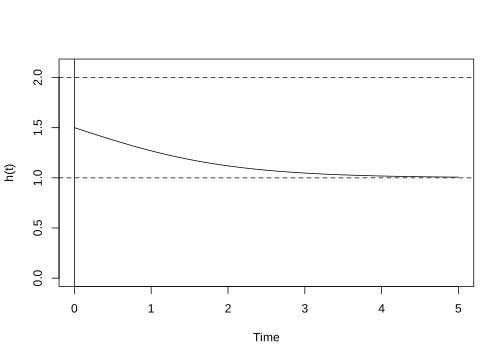
FIGURE 8.1: Population hazard function (solid line). The dashed lines are the hazard functions of each group, constant at 1 and 2.
The important point here is that it is impossible to tell from data alone whether the population is homogeneous, with all individuals following the same hazard function ((8.1), or if it in fact consists of two groups, each following a constant hazard rate. Therefore, individual frailty models like \(h_i(t) = Z_i h(t), \quad i = 1, \ldots, n\), where \(Z_i\) is the “frailty” for individual No. \(i\), and \(Z_1, \ldots, Z_n\) are independent and identically distributed (iid) are less useful.
A heuristic explanation to all this is the dynamics of the problem: We follow a population (cohort) over time, and the composition of it changes over time. The weaker individuals die first, and the proportion stronger will steadily grow as time goes by.
Another terminology is to distinguish between individual and population hazards. In Figure 8.1 the solid line is the population hazard, and the dashed lines represent the two kinds of individual hazards present. Of course, in a truly homogeneous population, these two concepts coincide.